Buy schachclub.eu ?
We are moving the project
schachclub.eu .
Are you interested in purchasing the domain
schachclub.eu ?
domain@kv-gmbh.de · 0541-91531010
Buy schachclub.eu ?
Why do we need injectivity, surjectivity, or bijectivity?
Injectivity, surjectivity, and bijectivity are important concepts in mathematics because they help us understand the relationship between different sets and functions. Injectivity ensures that each element in the domain maps to a unique element in the codomain, which is useful for preventing information loss in functions. Surjectivity guarantees that every element in the codomain is mapped to by at least one element in the domain, ensuring that no information is left out. Bijectivity combines these two properties, providing a one-to-one correspondence between elements in the domain and codomain, making it easier to establish relationships and solve problems in various mathematical contexts. **
How can one show and justify the bijectivity?
One can show and justify the bijectivity of a function by demonstrating that it is both injective and surjective. Injectivity means that each element in the domain maps to a unique element in the codomain, while surjectivity means that every element in the codomain is mapped to by at least one element in the domain. By proving both of these properties, one can establish that the function is bijective, meaning it has a one-to-one correspondence between its domain and codomain. This can be done through mathematical proofs, such as using the definition of injectivity and surjectivity, or by showing the existence of an inverse function. **


Similar search terms for Bijectivity
Top-Angebote
Products related to Bijectivity:
-
Multicon Wholesale Hub Professional Digital Chess Clock Timer With Count Up & Count Down For Tournament And Training Games Professional Digital Chess Clock Timer With Count Up & Count Down For Tournament And Training GamesExperience smoother, more competitive gameplay with this chess clock timer designed for players who value precision and focus. Whether you're preparing for tournaments, practicing strategy, or enjoying casual matches at home, this timer helps keep...103,97 $*Shipping: 0,00 $Secure redirect to the provider
-
Multisell Products Hub Easy To Play Chess Board Game Toy, Educational Strategy Table Games Easy To Play Chess Board Game Toy, Educational Strategy Table GamesEngage Your Mind with a Classic Chess Board Game The Chess Board Game Toy is a timeless strategy game that offers endless fun for both beginners and experienced players. Designed to be easy to play, this game is perfect for improving focus,...49,97 $*Shipping: 0,00 $Secure redirect to the provider
-
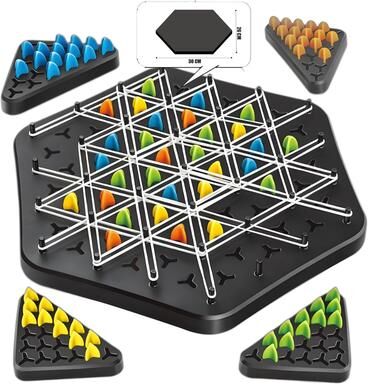
Uplift Picks Triangle Strategy Board Game Chain Chess Family Fun Logic Game 24x21 CmBring excitement to your game nights with this engaging strategy board game designed to challenge your thinking and spark fun competition. Perfect for both kids and adults, this family board game combines logic, planning, and interactive play. Its...47,98 $*Shipping: 0,00 $Secure redirect to the provider
-
Inspire Picks Magnetic Chess Board Game For Kids Strategy And Logical Thinking Fun ats30527 ASpark curiosity and sharpen young minds with a classic challenge made kidfriendly. This engaging magnetic chess board game helps children develop focus, patience, and problemsolving skills while having fun. Designed as a thoughtful educational logic...47,95 $*Shipping: 0,00 $Secure redirect to the provider


-
Examine the sets for injectivity, surjectivity, and bijectivity.
The sets can be examined for injectivity, surjectivity, and bijectivity by analyzing the relationship between the elements of the domain and the codomain. Injectivity can be determined by checking if each element in the domain maps to a unique element in the codomain. If there are no two distinct elements in the domain that map to the same element in the codomain, the function is injective. Surjectivity can be determined by checking if every element in the codomain has at least one pre-image in the domain. If every element in the codomain is mapped to by at least one element in the domain, the function is surjective. Bijectivity can be determined by checking if the function is both injective and surjective. If every element in the codomain has a unique pre-image in the domain, and every element in the codomain is mapped to, the function is bijective. **
-
What is the definition of injectivity, surjectivity, and bijectivity?
Injectivity refers to a function where each element in the domain maps to a unique element in the codomain. Surjectivity means that every element in the codomain is mapped to by at least one element in the domain. Bijectivity combines both injectivity and surjectivity, meaning that each element in the domain maps to a unique element in the codomain, and every element in the codomain is mapped to by at least one element in the domain. **
-
How do I prove injectivity, surjectivity, and bijectivity correctly?
To prove injectivity, you need to show that if f(x) = f(y), then x = y. This can be done by assuming f(x) = f(y) and then showing that x = y. To prove surjectivity, you need to show that for every y in the codomain, there exists an x in the domain such that f(x) = y. This can be done by taking an arbitrary y and finding an x that maps to it. To prove bijectivity, you need to show both injectivity and surjectivity. This can be done by proving that f is injective and surjective. **
-
How can one prove bijectivity and countability through identity?
One can prove bijectivity by showing that for every element in the domain, there is a unique corresponding element in the codomain, and vice versa. This can be done through the use of the identity function, which maps each element to itself. If the identity function can be shown to be both injective (no two distinct elements in the domain map to the same element in the codomain) and surjective (every element in the codomain is mapped to by an element in the domain), then the function is bijective. Countability can also be proven through identity by showing that a set is countable if and only if there exists a bijection between the set and the natural numbers. By constructing a bijection between a set and the natural numbers using the identity function, one can prove that the set is countable. This is because the identity function maps each element in the set to a unique natural number, demonstrating that the set can be put into one-to-one correspondence with the natural **

What is the purpose of injectivity, surjectivity, or bijectivity?
The purpose of injectivity, surjectivity, and bijectivity is to understand and describe the relationship between two sets. Injectivity ensures that each element in the domain maps to a unique element in the codomain, surjectivity ensures that every element in the codomain is mapped to by at least one element in the domain, and bijectivity combines both properties to ensure that there is a one-to-one correspondence between the elements of the domain and the codomain. These properties are important in various areas of mathematics, such as function theory, linear algebra, and set theory, and help to characterize the behavior of functions and relations between sets. **
'Against the grandmaster in chess?'
Playing against a grandmaster in chess can be an incredibly challenging and intimidating experience. Grandmasters are among the best players in the world, with a deep understanding of the game and exceptional strategic skills. It is important to approach the game with humility and a willingness to learn, as playing against a grandmaster can provide valuable insights and opportunities for improvement. While the odds of winning may be slim, the experience of facing off against a grandmaster can be a valuable learning opportunity and a memorable experience for any chess enthusiast. **
Top-Angebote
Products related to Bijectivity:
-
Everyday Crate ElitePro Digital Chess Timer & Go Game Clock With 42 Tournament Timing Modes ElitePro Digital Chess Timer & Go Game Clock With 42 Tournament Timing ModesEvery move counts when the pressure is on. Designed for competitive players, clubs, coaches, and tournament organizers, this advanced digital chess clock delivers precise, reliable time control for intense matches. With 42 preset timing rules across...64,97 $*Shipping: 0,00 $Secure redirect to the provider
-
Inspired Living Classic Staunton Wooden Chess Pieces Set (32pcs) Tournament Chessmen Replacement Set bBring the timeless elegance of chess back to your table with wooden chess pieces that feel as good as they look. This complete 32piece set is designed for players who want a classic, balanced style thats easy to recognize and satisfying to play...23,97 $*Shipping: 0,00 $Secure redirect to the provider
-
Multicon Wholesale Hub Professional Digital Chess Clock Timer With Count Up & Count Down For Tournament And Training Games Professional Digital Chess Clock Timer With Count Up & Count Down For Tournament And Training GamesExperience smoother, more competitive gameplay with this chess clock timer designed for players who value precision and focus. Whether you're preparing for tournaments, practicing strategy, or enjoying casual matches at home, this timer helps keep...103,97 $*Shipping: 0,00 $Secure redirect to the provider
-
Multisell Products Hub Easy To Play Chess Board Game Toy, Educational Strategy Table Games Easy To Play Chess Board Game Toy, Educational Strategy Table GamesEngage Your Mind with a Classic Chess Board Game The Chess Board Game Toy is a timeless strategy game that offers endless fun for both beginners and experienced players. Designed to be easy to play, this game is perfect for improving focus,...49,97 $*Shipping: 0,00 $Secure redirect to the provider
-
Why do we need injectivity, surjectivity, or bijectivity?
Injectivity, surjectivity, and bijectivity are important concepts in mathematics because they help us understand the relationship between different sets and functions. Injectivity ensures that each element in the domain maps to a unique element in the codomain, which is useful for preventing information loss in functions. Surjectivity guarantees that every element in the codomain is mapped to by at least one element in the domain, ensuring that no information is left out. Bijectivity combines these two properties, providing a one-to-one correspondence between elements in the domain and codomain, making it easier to establish relationships and solve problems in various mathematical contexts. **
-
How can one show and justify the bijectivity?
One can show and justify the bijectivity of a function by demonstrating that it is both injective and surjective. Injectivity means that each element in the domain maps to a unique element in the codomain, while surjectivity means that every element in the codomain is mapped to by at least one element in the domain. By proving both of these properties, one can establish that the function is bijective, meaning it has a one-to-one correspondence between its domain and codomain. This can be done through mathematical proofs, such as using the definition of injectivity and surjectivity, or by showing the existence of an inverse function. **
-
Examine the sets for injectivity, surjectivity, and bijectivity.
The sets can be examined for injectivity, surjectivity, and bijectivity by analyzing the relationship between the elements of the domain and the codomain. Injectivity can be determined by checking if each element in the domain maps to a unique element in the codomain. If there are no two distinct elements in the domain that map to the same element in the codomain, the function is injective. Surjectivity can be determined by checking if every element in the codomain has at least one pre-image in the domain. If every element in the codomain is mapped to by at least one element in the domain, the function is surjective. Bijectivity can be determined by checking if the function is both injective and surjective. If every element in the codomain has a unique pre-image in the domain, and every element in the codomain is mapped to, the function is bijective. **
-
What is the definition of injectivity, surjectivity, and bijectivity?
Injectivity refers to a function where each element in the domain maps to a unique element in the codomain. Surjectivity means that every element in the codomain is mapped to by at least one element in the domain. Bijectivity combines both injectivity and surjectivity, meaning that each element in the domain maps to a unique element in the codomain, and every element in the codomain is mapped to by at least one element in the domain. **
Similar search terms for Bijectivity
-
Uplift Picks Triangle Strategy Board Game Chain Chess Family Fun Logic Game 24x21 CmBring excitement to your game nights with this engaging strategy board game designed to challenge your thinking and spark fun competition. Perfect for both kids and adults, this family board game combines logic, planning, and interactive play. Its...47,98 $*Shipping: 0,00 $Secure redirect to the provider
-
Inspire Picks Magnetic Chess Board Game For Kids Strategy And Logical Thinking Fun ats30527 ASpark curiosity and sharpen young minds with a classic challenge made kidfriendly. This engaging magnetic chess board game helps children develop focus, patience, and problemsolving skills while having fun. Designed as a thoughtful educational logic...47,95 $*Shipping: 0,00 $Secure redirect to the provider
-
Inspired Living Classic Staunton Wooden Chess Pieces Set (32pcs) Tournament Chessmen Replacement Set aBring the timeless elegance of chess back to your table with wooden chess pieces that feel as good as they look. This complete 32piece set is designed for players who want a classic, balanced style thats easy to recognize and satisfying to play...23,97 $*Shipping: 0,00 $Secure redirect to the provider
-
Uplift Picks Triangle Strategy Board Game Chain Chess Family Fun Logic Game 30x26 CmBring excitement to your game nights with this engaging strategy board game designed to challenge your thinking and spark fun competition. Perfect for both kids and adults, this family board game combines logic, planning, and interactive play. Its...57,98 $*Shipping: 0,00 $Secure redirect to the provider
-
How do I prove injectivity, surjectivity, and bijectivity correctly?
To prove injectivity, you need to show that if f(x) = f(y), then x = y. This can be done by assuming f(x) = f(y) and then showing that x = y. To prove surjectivity, you need to show that for every y in the codomain, there exists an x in the domain such that f(x) = y. This can be done by taking an arbitrary y and finding an x that maps to it. To prove bijectivity, you need to show both injectivity and surjectivity. This can be done by proving that f is injective and surjective. **
-
How can one prove bijectivity and countability through identity?
One can prove bijectivity by showing that for every element in the domain, there is a unique corresponding element in the codomain, and vice versa. This can be done through the use of the identity function, which maps each element to itself. If the identity function can be shown to be both injective (no two distinct elements in the domain map to the same element in the codomain) and surjective (every element in the codomain is mapped to by an element in the domain), then the function is bijective. Countability can also be proven through identity by showing that a set is countable if and only if there exists a bijection between the set and the natural numbers. By constructing a bijection between a set and the natural numbers using the identity function, one can prove that the set is countable. This is because the identity function maps each element in the set to a unique natural number, demonstrating that the set can be put into one-to-one correspondence with the natural **
-
What is the purpose of injectivity, surjectivity, or bijectivity?
The purpose of injectivity, surjectivity, and bijectivity is to understand and describe the relationship between two sets. Injectivity ensures that each element in the domain maps to a unique element in the codomain, surjectivity ensures that every element in the codomain is mapped to by at least one element in the domain, and bijectivity combines both properties to ensure that there is a one-to-one correspondence between the elements of the domain and the codomain. These properties are important in various areas of mathematics, such as function theory, linear algebra, and set theory, and help to characterize the behavior of functions and relations between sets. **
-
'Against the grandmaster in chess?'
Playing against a grandmaster in chess can be an incredibly challenging and intimidating experience. Grandmasters are among the best players in the world, with a deep understanding of the game and exceptional strategic skills. It is important to approach the game with humility and a willingness to learn, as playing against a grandmaster can provide valuable insights and opportunities for improvement. While the odds of winning may be slim, the experience of facing off against a grandmaster can be a valuable learning opportunity and a memorable experience for any chess enthusiast. **
* All prices are inclusive of VAT and, if applicable, plus shipping costs. The offer information is based on the details provided by the respective shop and is updated through automated processes. Real-time updates do not occur, so deviations can occur in individual cases. ** Note: Parts of this content were created by AI.